Core Data Lab
macOS / developpeurs
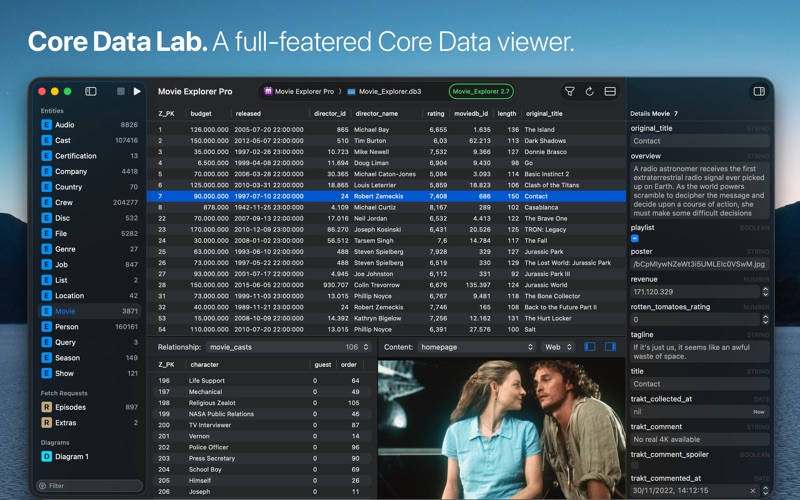
Core Data Lab lets you easily view, edit, and analyse data of SQLite-based Core Data and SwiftData apps. View, track, and explore what’s inside your Core Data database, including all Core Data-specific details like relationships, entity descriptions, fetch request templates, composite attributes, and more.
Quick start
• Set up a new project in a few easy steps using the project assistant.
• Select an app or model file and let Core Data Lab search for a matching database.
• Or select a database file and let Core Data Lab search for matching apps.
• Or use the simulator browser to select a database and app combination in one go.
Data change tracker
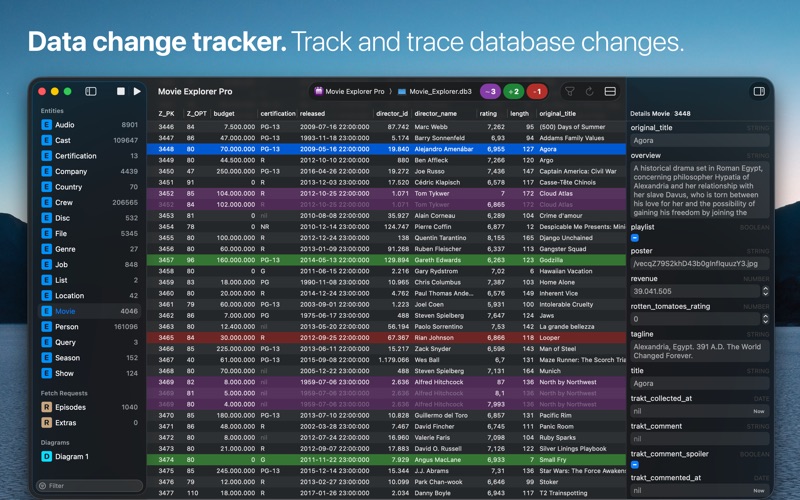
• Hit the Play button on the toolbar to start tracking database changes.
• New, deleted, and changed data rows are displayed with distinct colors.
• Each previous row version is displayed individually, including all value changes.
• No need to change your project or implement special libraries.
• Works with macOS apps and apps running in an iOS, iPadOS, watchOS, tvOS or visionOS simulator.
Data filter
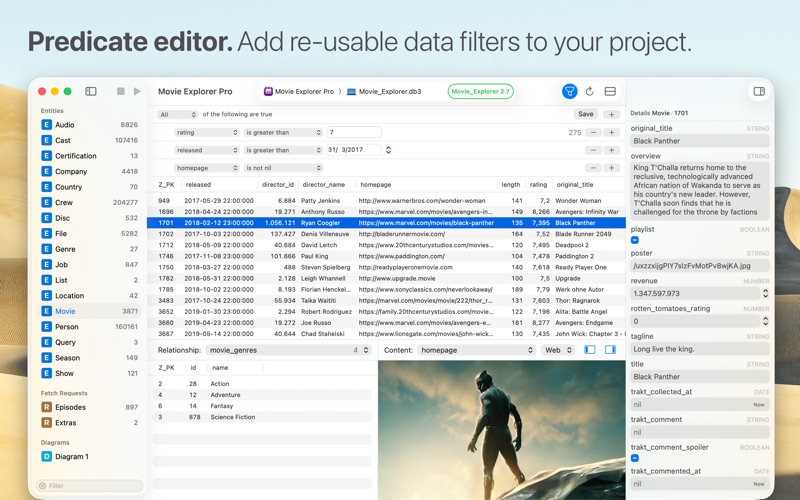
• Use the built-in easy-to-use predicate editor to filter and query your data.
• Save predicates as part of a Core Data Lab project for easy access.
• Duplicate predicates to make quick variants of the same filter.
Data editor
• Edit and create data directly in the inspector panel or detail window.
• Delete rows directly in the data grid.
• Change, replace, or nullify data with batch updates.
• All data mutations are validated by the active Core Data Object model.
Relationships viewer
• View instantly all relationships and related data of a selected row.
• Easily switch to another relationship.
• Selecting a row in the relationship panel will show the data in the inspector panel.
Simulator browser
• Browse local iOS, iPadOS, watchOS, tvOS or visionOS simulators for Core Data apps and databases.
• Add app and database combinations with one click to your project.
Object model diagrams
• Visualize your Core Data model in one or more diagrams, showing all entities, attributes, fetched properties, and relationships.
• Inspired by the ‘graph style’ editor of the data model designer tool in Xcode 13 and older.
• Exportable to PDF and clipboard.
Content viewer
• Automatic detection and display of web links, image data, HTML content, PLIST objects, binary content, and more.
• Switch to Text view to inspect the HTML, XML, or JSON text content of web links.
• Built-in HTML debugger.
Entity description viewer
• View all details of all attributes of a selected Core Data entity.
• Inspect all other details like relationships, indexes, and constraints.
Raw data viewer
• Open and view SQLite databases without a Core Data object model.
• Support for opening SQLite files in the Finder.
Data import
• Import data using CSV or JSON files.
• JSON import supports relationship data and composite attributes.
• All data import happens under validation of the active Core Data Object model.
Data export
• Export a selected row or table to CSV or JSON.
• Export data tracking data to CSV or JSON including history data.
• JSON export supports relationship data and composite attributes.
• CSV data can be viewed and further processed in Excel or Numbers.
Project-based
• Your database, app, and model references are stored in a Core Data Lab project.
• Data filters, selections, sorting settings, and diagrams are also part of the same project.
• This makes it easy to stop and continue working with your data, without recreating anything.
• Projects are saved as standard NSDocument files, including tabbed windows, auto-save, and more.
Support
If you encounter problems with this app, then please take a look at the Core Data Lab help page at https://betamagic.nl/support/coredatalab/help.html. If this doesn’t provide the solution you are looking for, or you miss some essential features, just contact us at support@betamagic.nl.
Quoi de neuf dans la dernière version ?
• Full Liquid Glass support, including a new app icon with support for icon styles in macOS 26.
• Favorite Attributes let you put attributes in front or on top of other attributes in tables and forms, making it easier to identify and work with your data.
• Favorite Content controls which attributes should be displayed first in the content viewer panel.
• New Relationships panel in the Object editor window, which allows you to view the relationship data of multiple objects side-by-side.
• Visualize your data model with diagrams, heavily inspired by the ‘graph style’ editor of the data model designer tool in Xcode 13 and older.
Other improvements:
• Search within webpages in the content viewer.
• More supported image formats in the content viewer.
• Native document title display and editing features.
• Improved large text performance.
• Startup options in the app settings.
• Improved handling of canceling editing of data.