
Planetarium 3D
iOS Universel / Divertissement
The solar system in your hands — not as a star map, but as a place you actually fly through.
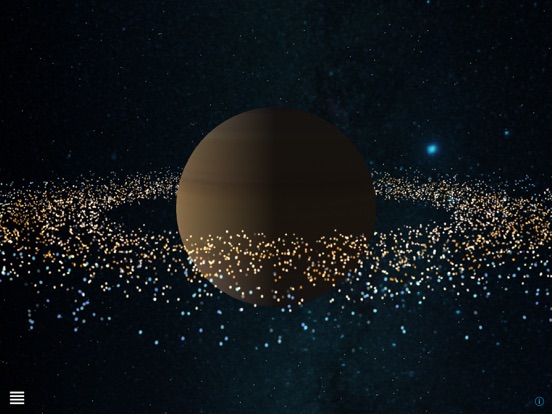
Drag to spin. Pinch to zoom. Tap any planet and watch the camera launch across space to meet it. Saturn's rings fill your screen. Jupiter's storm has been raging for 350 years. Pluto and Charon orbit each other like a pair of dancers. Every detail is real.
Fly the Grand Tour
One tap launches a cinematic journey from Neptune inward to the Sun — the same route Voyager 2 made famous. Three different flight styles rotate randomly so no two tours feel alike: sweep alongside a planet's orbit, dive from polar altitude, or pass in close formation. Every flyby triggers a fact card with the one thing about that world that will stick with you.
Land on any planet
Tap a planet and fly there. Orbit it. Tap its moons — Europa's hidden ocean, Titan's methane lakes, Triton spiralling slowly to its destruction. Every moon has its own card with real NASA data.
Built for wonder, not complexity
No account. No telescope required. No AR camera pointed at your ceiling. Just open it and you're in space.
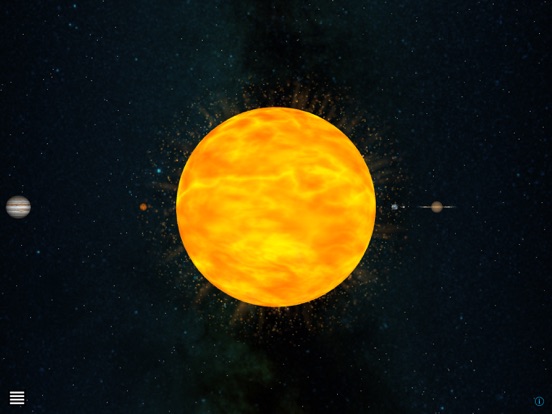
Accurate science. Real orbital mechanics. NASA fact-sheet data for all 9 planets and 20 moons. Atmosphere shaders, volumetric sun bloom, particle star fields, cinematic FOV shifts.
Quoi de neuf dans la dernière version ?
Eight years is a long time in space.
This update is a complete rebuild. Nothing from the previous version survives except the idea.
Fly there. Tap any planet and the camera launches across the solar system to meet it. No menus. No lists. Just go.
The Grand Tour. One button sends you on a cinematic journey from Neptune inward to the Sun — three different flight styles, randomised every time. Orbital sweeps. Polar dives. Close passes beside Saturn's rings. Flyby cards with real facts at every planet.
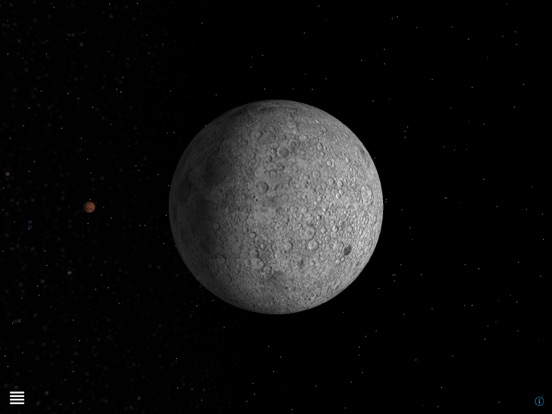
Moons. Twenty of them, each with real NASA data. Tap Europa's icy shell. Read about Titan's methane lakes. Watch Triton orbit backwards toward its eventual destruction.
It looks different too. Atmosphere bloom on Earth, Venus, Mars and Titan. Volumetric sun shader. Particle star field. Cinematic FOV shifts during flight. Rings on Jupiter, Saturn, Uranus and Neptune.
11 languages. English, German, Spanish, French, Chinese, Japanese, Arabic, Italian, Portuguese, Korean, Hindi.
If you loved the original, thank you for waiting. This is what it always should have been.