DiscretePath
macOS / Productivité
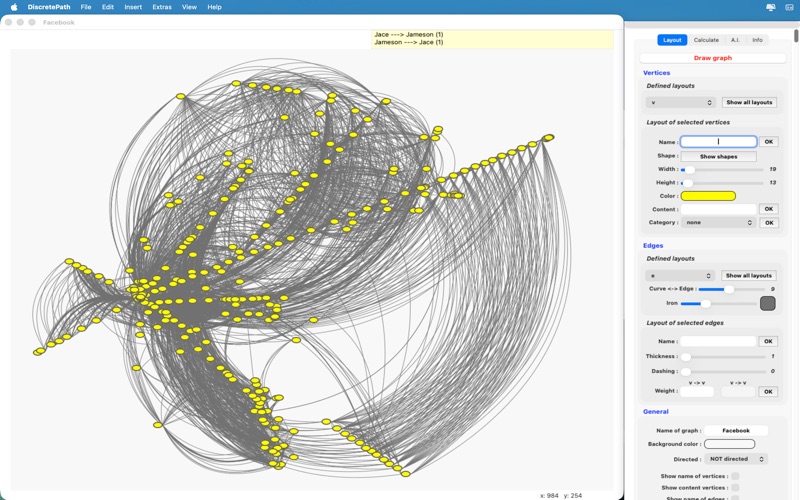
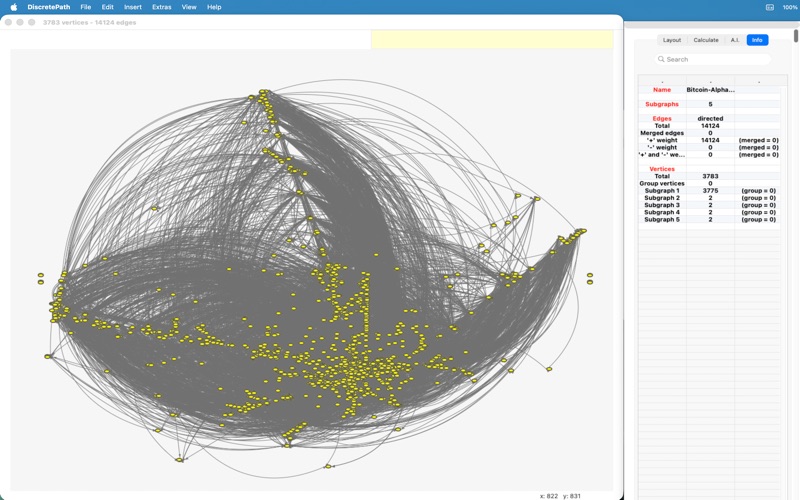
‘DiscretePath’ is software for drawing, visualizing and analyzing medium-sized graphs (networks). Graphs of up to 20,000 edges (links) can be drawn in a reasonable amount of time. Larger graphs can also be imported and drawn, but this takes longer. Most analyzes (paths, flows, centralities, clustering, cliques, ...) can be performed on medium-sized graphs, except when non-polynomial algorithms are used or very complex matrices need to be constructed.
In addition to the drawing and analysis tools, an Artificial Intelligence module covers AI algorithms that use graphs in one form or another. The supervised learning AI algorithms covered are: "Decision Trees" and "Graph Similarity". The decision tree algorithms can handle both categorical and numerical data and can be used for both classification and regression tasks. The Graph Similarity module compares the differences between two graphs based on the flows through their vertices.
Features:
- Draw a network as a graph, as a traditional tree or as radial tree
- Import network data as a list of edges, as an adjacency list, or as an adjacency matrix
- Import x,y-coordinates of the vertices (f.ex. vertices that represent locations on a map can be set to their latitude and longitude coordinates)
- Categories can be assigned to vertices
- Vertices can be organized in groups (improves graph layout, visualization and analysis)
- Shortest and longest path
- Maximum flow through the edges (and vertices)
- Global and minimum s-t cut
- Minimum spanning tree
- Centralities: degree centrality, vertex betweenness, edge betweenness, harmonic centrality
- Clustering methods based on: nearest neighborgh, hitting time, random walk
- Ability to perform sequential clustering to reduce the number of clusters and gain deeper insight into network structure
- Create random graphs
- Perform different types of random walks
- Identifying the maximum clique and all the cliques (minimum size can be selected)
- Decision models: based on single or ensemble of decision trees
- Graph similarity: compares the differences between two graphs based on the flows through their vertices
Quoi de neuf dans la dernière version ?
Improvements:
Code optimization of the analytical algorithms for faster performance.
Important bug fix:
In previous versions, adding or removing a vertex or edge, or creating or expanding a vertex group, could lead to a crash when the 'neighbors' of a vertex were selected via the contextual menu item of the canvas 'Show neighbors of 'vertex...'. This bug has been fixed.