Mela – AUv3: Synth, FX, MIDI
iOS Universel / Musique
DREAM UP AN INSTRUMENT, THEN BUILD IT
Mela is a modular music-making tool that grows with you, from your first patch to deep custom designs. Create polyphonic synthesisers, unique audio effects, and complex MIDI processors. Mela runs standalone on iOS and macOS, or as an AUv3 plug-in inside your favourite DAW, including Ableton Live, AUM, Cubasis, Drambo, and Logic Pro.
EVERYTHING IS A MODULE
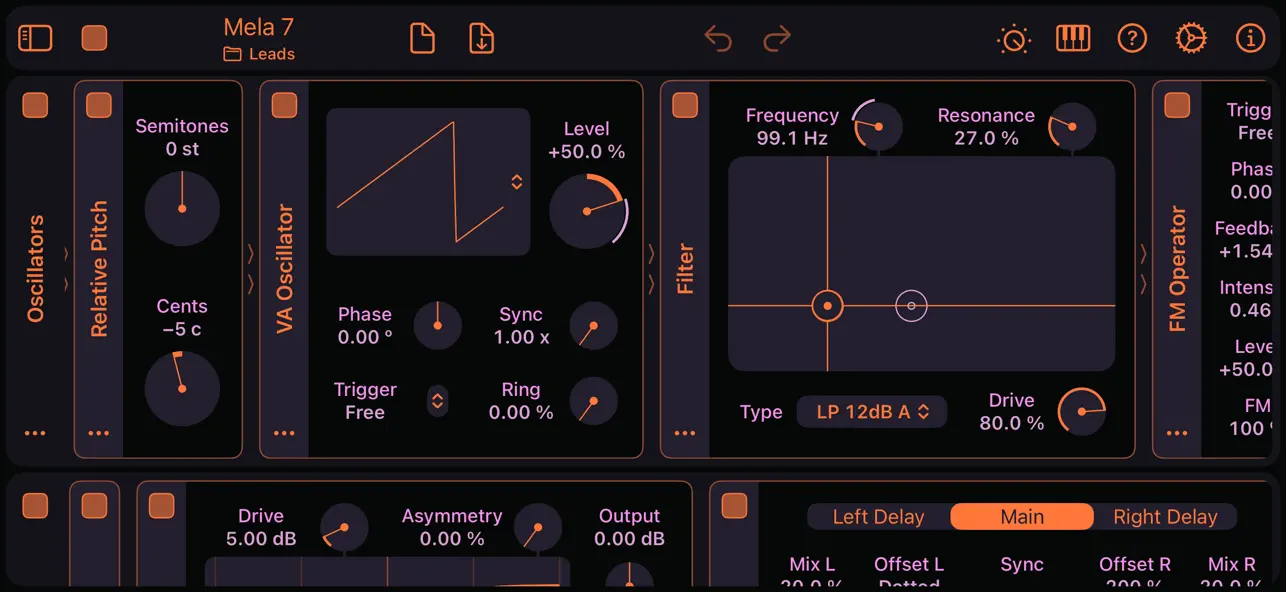
In Mela, there are no virtual cables to untangle. Instead, a patch is a tree of nested modules, where modules process their submodules in series or parallel. The layout of your patch is its signal flow. Everything moves with a drag, and a patch can stay tiny or grow into a deeply nested design.
MEET THE MODULES
Each module is focused yet powerful, and built-in help lets you quickly learn how it works. Here is a quick tour.
• MIDI processors: arpeggiator, chord, Euclidean sequencer, groove, note echo, note modifiers, quantiser, scale, strummer, MIDI capture.
• Synth building blocks: virtual-analog oscillator, FM operator, phaseshaping, noise, glide, unison, VA filter, amp envelope.
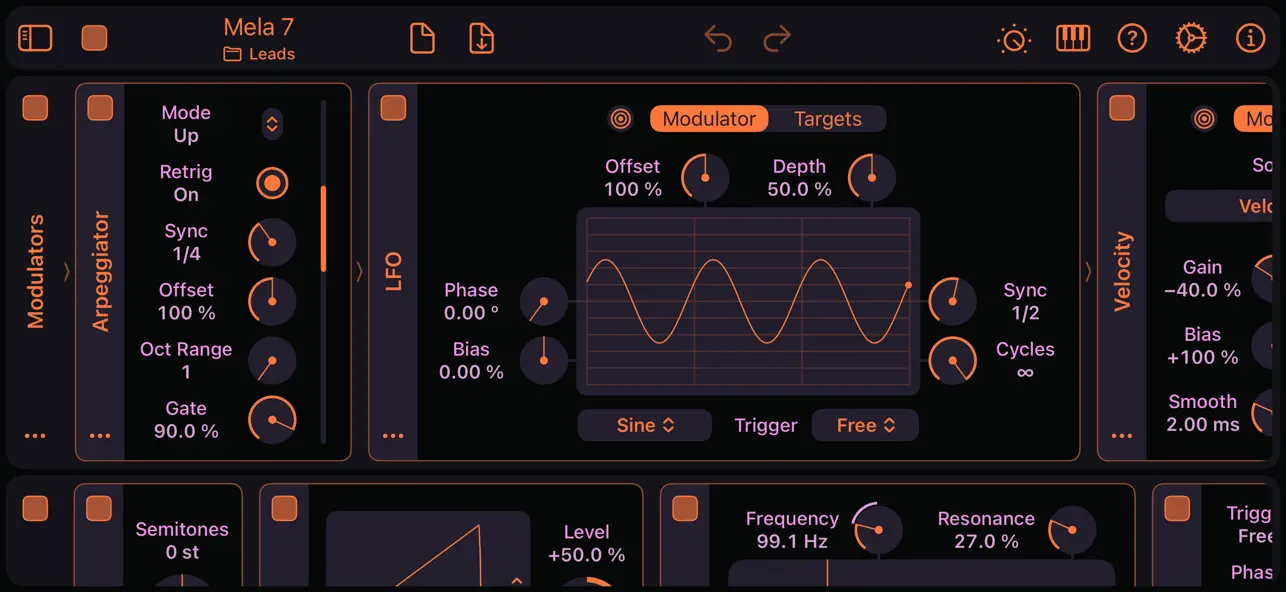
• Modulators: envelope generator, envelope follower, LFO, mod sequencer, XY pad, macro control, random.
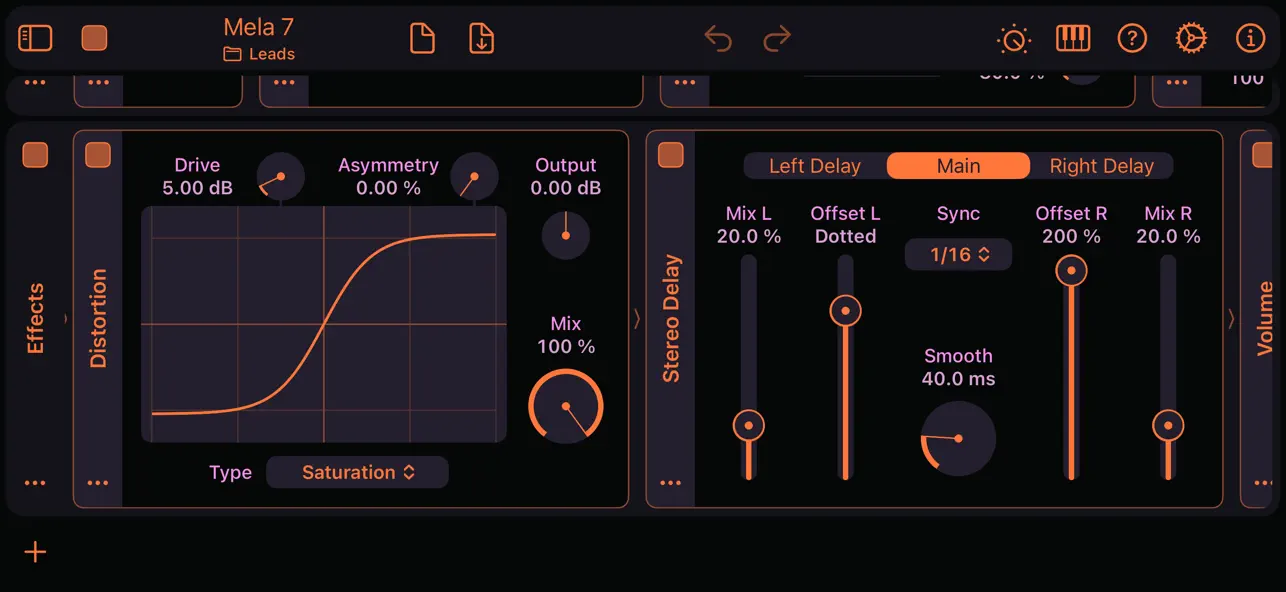
• Audio effects: reverb, delay, chorus, flanger, phaser, distortion, ring mod, dynamics, EQ, pitch and frequency shifters, stereo tools.
• Visualisers: level and correlation metering, oscilloscopes, MIDI logger, notepad.
The full module list is at the very end.
MODULATE ANY PARAMETER
Every module parameter in Mela can be targeted by modulator modules with sample-accurate, polyphonic modulation. The full parameter tree is also exposed to the DAW for automation.
YOUR FIRST PATCH
Load Mela as an Instrument, an Audio Effect, or a MIDI Processor, then take your pick: over 200 included patches to play, pull apart, and learn from, or a blank patch and total freedom.
PAY ONCE, OWN FOREVER
Mela ships with 109 modules and counting, organised into collections. Collection 0 is free and has everything you need to learn how Mela works. The rest are single purchases. A patch that uses modules you do not own still plays in full. Locked modules process signals as normal, and a purchase simply unlocks their controls.
SAY HELLO
Wondering if Mela can do something specific? Just ask. Questions often become short demo videos, and feature requests help guide what gets added next. Say hello, ask anything, and help shape where Mela goes next.
Contact: nikolozi.com/contact
User Guide: nikolozi.com/mela/user-guide
Tutorials: nikolozi.com/mela/tutorials
Changelog: nikolozi.com/mela/changelog
FAQ: nikolozi.com/mela/faq
COLLECTION 0
Amp Envelope, Arpeggiator, Audio In, Audio Out, Lane, LFO, Meter, MIDI In, MIDI Lane, MIDI Meter, MIDI Out, MIDI-to-Poly, Notepad, Overlap Remover, Poly-to-Mono, Relative Pitch, Stack, Stereo Delay, Transposer, VA Filter, VA Oscillator, Volume.
COLLECTION 1
Balance, Chord, Chorus, Compressor, Control Change, Distortion, DS Oscillator, Envelope Follower, Envelope Generator, Flanger, Glide, Level, MIDI Logger, MIDI Source, Noise, Note Echo, Note Length, Note Range, Note Stack, Phaser, Pitch Bend, Random, Scale, Strummer, Velocity.
COLLECTION 2
Clipper, Comb Filter, DC Blocker, Degrader, EQ Band, Fixed Pitch, FM Operator, Macro, MIDI Capture, MIDI Channel, Oscilloscope, Pitch Oscilloscope, Pitch Ratio, Rectifier, Vibrato, Voice Activity, VPS Oscillator.
COLLECTION 3
All Pass, Audio-to-Mod, Band Pass, Correlation, Digital Delay, Dual Pan, Euclid, Macro Button, Mid-Side, Multiply-Add, Noise Gate, Note Chance, Note Event, Pitch Follower, Reverb, Ring Mod, Simple LFO, Stereo Pan, Stereo Tool.
COLLECTION 4
Crossover, Delay, Effect, Feedback, Gain, Gain Computer, Groove, MIDI Delay, Note Hold, Note Pulse, Note-to-Pitch, Phase Distortion, Pitch Ramp, Quantiser, Splitter, Vel-to-Amp.
COLLECTION 5
CC Modulator, Frequency Shifter, Limiter, MIDI Echo, Mod Oscilloscope, Mod Steps, Pitch Shifter, Slew, Unison, XY.
Quoi de neuf dans la dernière version ?
Renamed Group to Lane
Group already represented a lane in practice, so renaming the module to Lane greatly simplifies the core concepts. A top-level lane is now simply a Lane submodule of the root Stack. For consistency, MIDI Group was also renamed to MIDI Lane. Note that the patch migrator will not rename modules with "Group" in their title, although the module type will change to Lane.
Other Changes
- Added support for 16-voice polyphony.
- Voice Activity: Updated the module to support 16 voices.
- Collapsed lanes now remain in place, so their visual layout reflects the signal-flow order, with consecutive collapsed lanes displayed side by side.
- Arpeggiator: Improved the Manual and Free modes by keeping the active note indicator visible alongside the Position slider.
- Patches: Patches with a Lane as the root now open with it as a top-level Lane instead of wrapping it in another Lane.
- Factory Patches: Added "Arp Improvisor" to MIDI FX and "Free Arpeggiator" to Subpatches to demonstrate Arpeggiator Free mode.
- Fixed a rare crash when the Pitch Ratio module was displayed before the host started rendering audio.
- Fixed a rare crash caused by hosts rendering larger audio buffers than the plug-in was configured for.